How Much Floor Space Do You Need for a 5-Axis CNC Bridge Saw?
2026-11-24 19:54:18
Click:
“
How Much Floor Space Do You Need for a 5-Axis CNC Bridge Saw?Investing in a 5-ax
”
How Much Floor Space Do You Need for a 5-Axis CNC Bridge Saw?
Investing in a 5-axis CNC bridge saw requires thorough workshop planning. Beyond the machine's static footprint, your actual floor plan must accommodate dynamic bridge movement, raw slab handling, operator safety, and auxiliary systems.
Typically, a standard industrial 5-axis bridge saw requires a dedicated operational area of at least 6 × 8 meters (20 × 26 ft) to operate at peak efficiency.

Key Factors for Workshop Layout Planning
1. Machine Footprint & Dynamic Travel Stroke
While a typical 5-axis saw measures around 5.5m (L) × 3.5m (W) × 2.8m (H), you must calculate the full stroke envelope of the gantry bridge and the 360° rotating spindle head to ensure zero collision hazards.
2. Raw Material Flow & Slab Handling
Processing oversized granite, marble, or engineered quartz slabs (up to 3.2m × 1.8m) demands clear logistics paths. Ensure sufficient ceiling height and turning radiuses for overhead bridge cranes, forklifts, or vacuum loading lifters.
3. Safety Clearance & Daily Maintenance
Industrial safety standards recommend maintaining a 1.0 to 1.5-meter (3–5 ft) clearance perimeter around the machine. This buffer zone ensures fast tool changing, easy blade replacement, and unobstructed access to the electrical cabinet.
4. Peripheral Support Systems
Factor in the spatial footprint of essential auxiliary equipment:
- Water recycling decanters and filtration units
- High-pressure air compressors
- Sludge collection bins and tool racking
Maximize Your Workshop Efficiency
Proper layout planning eliminates workflow bottlenecks, protects technicians, and prevents costly machine downtime.
Ready to upgrade your stone fabrication setup? Explore our 5-Axis CNC Bridge Saw Series to get free custom workshop layout support.
Author:
XIAMEN STONEPLUS MACHINERY CO., LTD.
0
More News
-

Automatic Tool Changer for Stone CNC Work Center | ATC Guide
-
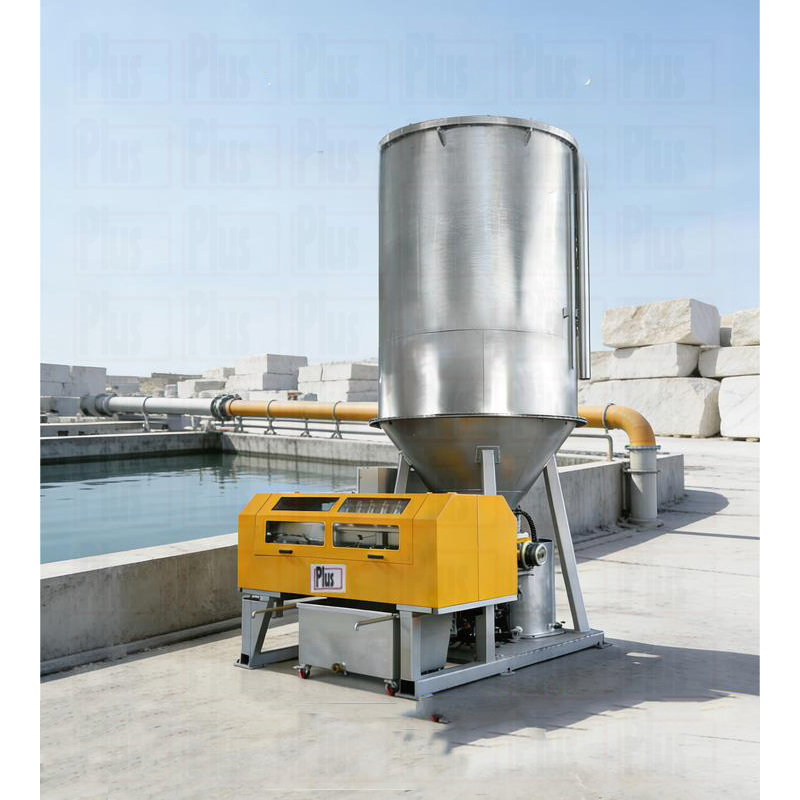
Monoblock Water Treatment Plant Ready for Global Delivery
-
5-Axis CNC Bridge Saw: Precision Sawing & Milling Test
-
Bridge Saw Worktable: Wood vs Rubber Top for Stone Cutting
-
50T Hydraulic Stone Splitting Machine for Cubes & Kerbs
-
4-Axis CNC Bridge Saw Factory Test: Precision Stone Cutting



-
Automatic Tool Changer for Stone CNC Work Center | ATC Guide
2026-11-26
Maximize Productivity with Automatic Tool Changing on Stone CNC Work CentersIn q
-
Monoblock Water Treatment Plant Ready for Global Delivery
2026-11-24
Compact Monoblock Water Treatment Plant Ready for DeliveryOur latest Monoblock W
-
5-Axis CNC Bridge Saw: Precision Sawing & Milling Test
2026-11-19
Precision in Motion: 5-Axis CNC Bridge Saw Factory Trial RunToday’s factory tria
-
Bridge Saw Worktable: Wood vs Rubber Top for Stone Cutting
2026-11-16
Bridge Saw Worktable: Wood vs Rubber Top for Stone CuttingA bridge saw worktable
-
50T Hydraulic Stone Splitting Machine for Cubes & Kerbs
2026-11-13
High-Efficiency 50T Hydraulic Stone Splitting Machine for Natural Face Finishing
-
4-Axis CNC Bridge Saw Factory Test: Precision Stone Cutting
2026-11-12
Precision in Action: Live Factory Test Cutting of the 4-Axis CNC Bridge SawEvery

Contact Us
 info@stoneplus.cn
 +86 592 6218808
 +86 13505053519
 No.11, Dongsheng Road, Andong Industrial Park, Jinjiang Economic Development Zone, Jinjiang, Fujian, 362200, China
Copyright © Stoneplus Machinery Co., Ltd. All Rights Reserved. Design:Peggy